When you think about supplements for building muscle and strength, protein powder, creatine, and caffeine probably come to mind first. But there's a micronutrient that might be flying under your radar — Vitamin B6. And here's the thing: about 60% of your body's B6 is stored directly in your muscle tissue. That's not a coincidence.
Vitamin B6 (pyridoxine) plays a critical role in virtually every pathway that matters for strength athletes — protein synthesis, energy production, recovery, and even muscle growth itself. Recent research suggests B6 might even act as an "exercise mimetic," triggering some of the same adaptive responses that happen when you lift heavy.
Let's break down the science and figure out whether you need to pay more attention to this often-overlooked vitamin.
What is Vitamin B6 and Why Should Lifters Care?
Vitamin B6 is a water-soluble vitamin that exists in three main forms: pyridoxine (the most common supplement form), pyridoxal, and pyridoxamine. Your body converts all of these to the active coenzyme form called pyridoxal 5'-phosphate, or PLP.
PLP is a cofactor for over 140 enzymatic reactions — more than almost any other vitamin. It's involved in amino acid metabolism, neurotransmitter synthesis, glycogen breakdown, and immune function. For strength athletes, the most relevant fact is this: approximately 60% of your body's vitamin B6 is found in skeletal muscle, with 75-95% of that muscle-bound B6 associated with glycogen phosphorylase, an enzyme that constitutes about 5% of muscle soluble protein.
This isn't just storage for the sake of storage. Glycogen phosphorylase is the enzyme that releases glucose from glycogen during exercise — literally fueling your lifts. Your muscles aren't just storing B6 there; they're putting it to work in one of the most critical energy pathways in your body.
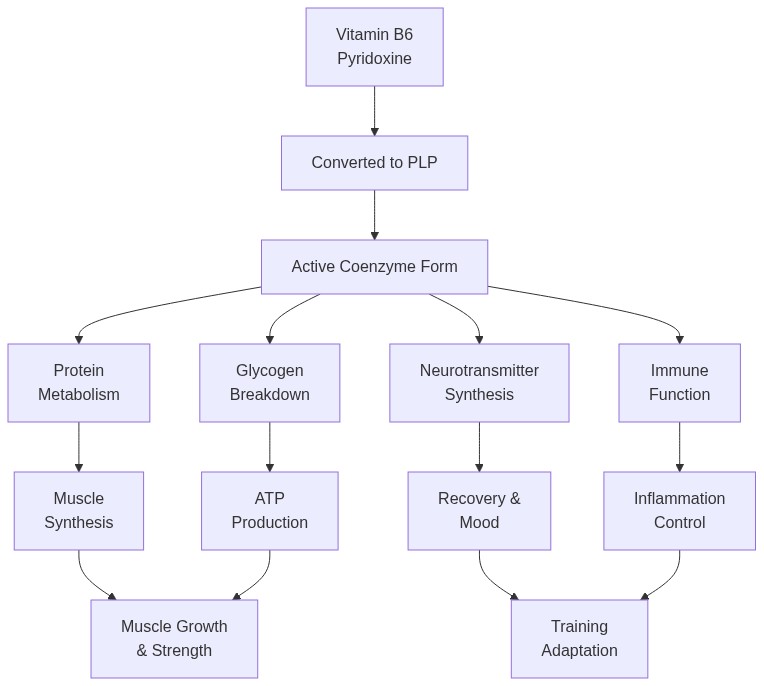
The Science: B6 and Muscle Protein Synthesis
If you're trying to build muscle, protein synthesis is the name of the game. Every rep, every set, every meal — it all revolves around creating an anabolic environment where your muscles build back stronger than before.
Vitamin B6 is a essential cofactor for protein metabolism. It serves as a coenzyme in transamination reactions, which are the process by which amino acids are shuffled around and converted into forms your body can use. Without adequate B6, your body can't efficiently process the protein you're eating — which means your gains are being bottlenecked at the metabolic level.
The research is surprisingly direct on this. A study comparing marginal B6-deficient diets to adequate B6 diets found that the normal diet tended to increase protein synthesis rates by about 26% compared to deficiency. That's a massive difference — we're not talking about a marginal improvement, we're talking about a quarter more muscle-building potential.
But it gets even more interesting. Research published in 2024 on whether Vitamin B6 acts as an "exercise mimetic" in skeletal muscle found that adequate B6 intake significantly increased the expression of genes responsible for:
- Myokines (muscle-secreted signaling molecules)
- Myogenesis (muscle fiber formation)
- Mitochondrial biogenesis (more energy factories in your cells)
- Energy metabolism overall
In plain English: B6 doesn't just help your muscles process protein — it may actually prime your muscles to grow in similar ways to what happens after a hard workout.
Energy Production and Exercise Performance
Strength training is energy-intensive. Whether you're grinding out a 5-rep max on squats or repping out 12 on curls, your body needs ATP — and plenty of it.
Vitamin B6 is deeply involved in energy production through multiple pathways. First, as mentioned, it's bound up in glycogen phosphorylase, which releases glucose from glycogen stores during exercise. This is your primary fuel source for high-intensity lifting.
Second, B6 plays a role in gluconeogenesis — the process by which your body creates new glucose from non-carbohydrate sources (like amino acids). This becomes important during prolonged training sessions or when you're in a caloric deficit and need to maintain blood sugar levels.
Third, B6 is a cofactor in reactions that convert carbohydrates, fats, and proteins into usable energy. Every macro you eat passes through B6-dependent pathways at some point.
Here's what that means practically: when you train hard, your B6 requirements increase. The 2000 study on thiamine, riboflavin, and B6 requirements in physically active people found that exercise does increase the need for these vitamins — and B6 is particularly important because of its central role in amino acid metabolism, which ramps up during hard training.
Recovery, Repair, and Injury Prevention
Training breaks down muscle tissue. Recovery builds it back up. Vitamin B6 is involved in recovery at multiple levels.
For starters, B6 is required for the synthesis of neurotransmitters like serotonin and dopamine. These aren't just "feel-good" chemicals — serotonin regulates mood, sleep, and appetite, while dopamine is involved in motivation and reward. Both affect your ability to train consistently and recover properly. Low B6 = compromised neurotransmitter synthesis = potentially lower motivation and worse sleep quality.
B6 also plays a role in immune function and inflammation regulation. Intense training causes inflammation — that's part of the adaptation process. But chronic excessive inflammation impairs recovery. B6 is involved in regulating inflammatory pathways, which means deficiency could throw off your recovery balance.
There's also the practical side: deficiency in B6 leads to muscle weakness, impaired coordination, and increased susceptibility to injury. If you've been feeling mysteriously weak in the gym despite training hard and eating enough, a B6 deficiency (or more commonly, marginal deficiency) could be part of the problem.
Dosage, Sources, and Supplementation
The RDA for vitamin B6 is 1.3-2.0 mg per day for adults, with the higher end recommended for older adults and pregnant women. However, the RDA is designed to prevent deficiency — not to optimize performance.
For strength athletes, the evidence suggests you may need more than the RDA. Many researchers and practitioners recommend 2-5 mg daily for active individuals, with some going higher. The key is finding your optimal range — more isn't necessarily better, as we'll discuss.
Food sources of B6 include:
- Poultry (chicken, turkey)
- Fish (salmon, tuna)
- Potatoes and sweet potatoes
- Bananas
- Chickpeas and other legumes
- Nuts and seeds
- Fortified cereals
If you're eating a varied diet with adequate protein, you're likely getting some B6. However, processing and cooking can reduce B6 content, and certain populations (older adults, people with digestive issues, those on certain medications) may have impaired absorption.
Supplementation considerations:
- Pyridoxine is the most common form in supplements
- Some evidence suggests pyridoxal-5-phosphate (P-5-P) may be more bioavailable, especially for older adults
- B6 works synergistically with other B vitamins (especially B12 and folate) — consider a B-complex if supplementing
Important warning: While B6 is water-soluble and generally safe, very high doses (over 200 mg daily for extended periods) can cause neurological symptoms including nerve damage and numbness. Stick to reasonable supplementation ranges and cycle if using high doses long-term.
Practical Recommendations for Strength Athletes
Here's where the rubber meets the road. What should you actually do?
First, assess your diet. If you're eating a standard varied diet with adequate protein (which you should be), you're probably getting enough B6 to avoid deficiency. Focus on including B6-rich foods regularly: chicken, fish, potatoes, bananas, and legumes.
Second, consider supplementation if:
- You're training intensely (6+ days per week)
- Your diet is restrictive or imbalanced
- You have digestive issues that affect nutrient absorption
- You've had blood work showing low B6
- You're feeling unusually fatigued or weak despite adequate training and sleep
Third, don't go crazy with the dose. 2-5 mg daily is a reasonable range for athletes. Going significantly higher offers unclear benefits and carries some risk.
Fourth, consider pairing B6 with other B vitamins. B vitamins work together — taking high-dose B6 without adequate B12 and folate may create imbalances. A quality B-complex is a safe bet.
Fifth, consider testing if you're concerned. Blood tests can measure B6 status. This is particularly useful if you've had persistent issues with fatigue, weakness, or poor recovery that haven't responded to other interventions.
Bottom Line
Vitamin B6 is a critical — but often overlooked — nutrient for strength athletes. With 60% of your body's B6 stored in muscle tissue and involved in everything from protein synthesis to glycogen breakdown to neurotransmitter production, ignoring this vitamin means leaving gains on the table.
The research is clear: marginal B6 deficiency impairs protein synthesis by around 26%, while adequate intake supports the gene expression pathways that drive muscle growth. Hard training increases your B6 requirements, and many athletes may be running slightly suboptimal without realizing it.
The good news? It's an easy fix. Eat B6-rich foods regularly, consider a modest 2-5 mg supplement if you're training hard, and don't stress about it. Unlike some supplements where the evidence is shaky, B6 has solid science behind its importance for strength athletes.
Don't let a micronutrient deficiency be the thing holding back your gains.