Omega-3 Fatty Acids for Strength Athletes: The Complete Science
Introduction
If you've spent any time in the supplement aisle, you've seen them: bottles of fish oil capsules promising everything from heart health to better skin. But for strength athletes, the question is simpler and more specific: will omega-3 fatty acids help me build more muscle and recover faster?
The short answer is yes—but with important caveats. The science on omega-3s and muscle protein synthesis is genuinely promising, though it's more nuanced than the marketing claims suggest. This article breaks down exactly what the research shows, how to dose properly, and when you're better off eating actual fish instead of reaching for a supplement.
Let's start with what you're actually dealing with.
What Are Omega-3s?
Omega-3 fatty acids are polyunsaturated fats classified into three main types:
- EPA (eicosapentaenoic acid): Primarily involved in inflammation regulation and cardiovascular health
- DHA (docosahexaenoic acid): Critical for brain function and cell membrane structure
- ALA (alpha-linolenic plant): Found in flaxseeds, chia, and walnuts—poorly converted to EPA/DHA in humans
For athletes, EPA and DHA are the relevant players. These are found predominantly in fatty fish and marine-based supplements. The body can't efficiently manufacture them, which means you either eat them or supplement them.
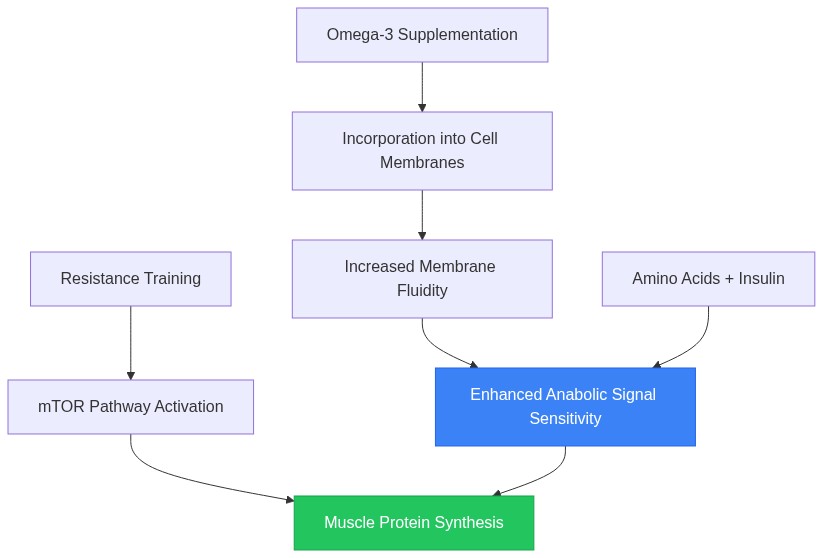
The reason athletes should care: omega-3s become incorporated into cell membrane phospholipids, literally changing how your muscle cells function at a fundamental level.
The Muscle Protein Synthesis Mechanism
This is where it gets interesting. The mechanism by which omega-3s enhance muscle protein synthesis (MPS) isn't about directly "building" muscle—it's about creating the conditions where your body is more responsive to the actual muscle-building stimuli you provide in the gym.
When you lift weights, you create a demand signal for muscle repair. Your body responds by activating the mTOR (mechanistic target of rapamycin) pathway, which initiates MPS. Several studies now show that omega-3 supplementation amplifies this response.
The mechanism works through membrane phospholipid enrichment. Omega-3s incorporate into muscle cell membranes, making them more fluid and responsive to anabolic signals. Research published in the American Journal of Clinical Nutrition found that omega-3 supplementation increased the sensitivity of muscle protein synthesis to amino acids and insulin—two critical drivers of muscle growth.
In practical terms: if you're already eating enough protein and training properly, omega-3s may help you squeeze more mileage out of both. They're not a magic bullet, but they appear to make your body more "anabolically sensitive."
The Research: What Studies Show
The evidence falls into two categories, and it's important to distinguish between them.
Acute studies (single-meal experiments) show robust effects. When researchers give participants omega-3s and then measure MPS response to amino acids, the results are consistently positive—sometimes showing 20-30% greater MPS rates compared to control groups. These lab-based findings established the mechanism.
Long-term training studies are more mixed but still encouraging. A 2015 meta-analysis in the British Journal of Sports Medicine found that omega-3 supplementation produced small but statistically significant increases in muscle mass and strength in older adults undergoing resistance training. More recent studies in younger athletic populations show similar trends, though effect sizes are modest—typically 0.5-1 kg more lean mass over 8-12 weeks compared to placebo.
The dose-response relationship matters here. Studies showing the strongest effects typically used 2-3 grams daily of combined EPA/DHA. Lower doses (under 1 gram) rarely produce meaningful results in trained individuals.
What this tells us: omega-3s appear to work best as a subtle amplifier of your existing training and nutrition habits. If those habits are poor, omega-3s won't compensate. If they're solid, omega-3s may provide a marginal but meaningful edge.
Anti-Inflammatory Effects & Recovery
Beyond direct muscle-building effects, omega-3s have significant implications for recovery and inflammation management.
Exercise creates inflammation—it's a necessary part of the adaptation process. But excessive or poorly managed inflammation can blunt recovery and increase injury risk. Omega-3s act as prostaglandin regulators, shifting the inflammatory cascade toward a more balanced resolution phase rather than a prolonged inflammatory state.
The evidence for delayed onset muscle soreness (DOMS) reduction is moderate. Several studies show meaningful reductions in DOMS ratings following intense exercise in omega-3 supplemented groups, though the effect isn't universal across all research. The anti-inflammatory mechanisms likely contribute to faster recovery between sessions, allowing for higher training frequency over time.
For athletes pushing high volumes or training frequently, this may be where omega-3s provide their most practical value—not in directly building muscle, but in keeping you recovered enough to train harder more often.
Optimal Dosage for Athletes
Here's where specificity matters. Most general health recommendations suggest 250-500mg of combined EPA/DHA daily—enough for basic heart health but nowhere near what's used in the muscle-building research.
For strength athletes, the evidence supports 2-3 grams daily of combined EPA and DHA. This is 5-10 times more than general recommendations. You'll need to read labels carefully—many "fish oil" supplements are low in EPA/DHA per softgel, with much of the weight being other fats.
Key considerations:
- Form: Triglyceride form is better absorbed than ethyl ester form, though both work. Algae-based omega-3s are an effective option for vegetarians/vegans and provide DHA (and sometimes EPA)
- Quality: Look for products that test for heavy metals and oxidation. Fish oil goes rancid easily—check for a "best by" date and store in a cool, dark place
- Timing: Take with meals. Omega-3s are fat-soluble and absorption improves with dietary fat
- Divided dosing: Splitting 2-3g across two doses (morning and evening) may improve tolerance and absorption
A note on dosage math: if a product says "1000mg fish oil" per softgel, that doesn't mean 1000mg of EPA/DHA. You'll typically see "500mg omega-3s" which may only contain 200-300mg of EPA/DHA. Read the specific EPA/DHA content, not the total fish oil weight.
Food Sources vs. Supplementation
This is a rare case where food sources genuinely compete with supplements.
Fatty fish are excellent sources of EPA and DHA:
- Salmon (wild-caught): ~2g EPA+DHA per 100g serving
- Mackerel: ~2.5g per 100g
- Sardines: ~1.5g per 100g
- Herring: ~2g per 100g
To match a 2g daily EPA/DHA supplement dose through food alone, you'd need roughly one 100g serving of salmon or mackerel daily—or about two servings of fattier fish like sardines.
When food beats pills:
- If you eat fatty fish 2-3 times weekly, you may not need supplementation
- Whole foods provide additional nutrients (vitamin D, selenium, B12) that isolated supplements don't
- Food sources have no oxidation concerns
When supplementation makes sense:
- You don't eat fish regularly
- You need consistent daily dosing (travel, convenience)
- You want guaranteed EPA/DHA levels without variable fish quality
- You're vegetarian/vegan (algae oil is the solution)
For most lifters eating fish occasionally, a daily supplement is probably worth it. For those eating salmon three times weekly, the added benefit of supplementation is marginal.
Practical Recommendations
Who should supplement:
- Athletes not eating fatty fish 2+ times weekly
- Anyone looking to optimize recovery between training sessions
- Older athletes concerned with maintaining muscle mass
- Vegetarians/vegans (using algae oil)
Dosing protocol:
- Target: 2-3g combined EPA/DHA daily
- Split into two doses with meals if possible
- Choose triglyceride form when possible
- Store properly, check expiration dates
Stacking with other supplements: Omega-3s stack well with the major muscle-building supplements:
- Protein: No interaction; take together for convenience
- Creatine: No interaction; both are well-researched and complementary
- Vitamin D: Often taken together; fat-soluble, so simultaneous dosing makes sense
- Caffeine: No significant interaction
Potential side effects: High-dose omega-3s can cause:
- Fishy burps (mitigated by cold-water fish oils, taking with meals, or divided dosing)
- Digestive upset at very high doses (above 5g)
- Blood thinning effects at pharmacological doses (relevant if taking anticoagulants)
For most healthy adults, 2-3g daily is well-tolerated and safe.
The Bottom Line
Omega-3 fatty acids are one of the few supplements with a plausible mechanism for enhancing muscle protein synthesis in strength athletes. The research supports modest but real benefits—for muscle mass, strength, and recovery—particularly when used at doses higher than general health recommendations.
For lifters: Take 2-3g of EPA/DHA daily, ideally from fish oil or quality algae oil. If you eat fatty fish regularly, you may not need supplementation. If you don't, this is one of the few supplements worth taking consistently.
They're not going to transform your physique overnight. But as part of a solid training and nutrition foundation, omega-3s are a research-backed piece of the optimization puzzle—and that's exactly what separates athletes who improve from those who plateau.