If you're serious about lifting, you've probably obsessed over protein, creatine, and caffeine. But there's one micronutrient that flies under the radar despite being absolutely critical for strength performance: Vitamin B12. This isn't just another supplement to add to the pile—it's the foundation upon which your body builds muscle, sustains energy, and recovers from brutal training sessions.
What is Vitamin B12 and Why Athletes Need It
Vitamin B12, also known as cobalamin, is a water-soluble vitamin that plays a role in virtually every cell in your body. Unlike some nutrients you can get from plants, B12 is almost exclusively found in animal products—meat, fish, eggs, and dairy. This makes it a particular concern for vegan and vegetarian lifters, but even carnivores can fall short.
B12 comes in several forms, and not all are created equal:
- Methylcobalamin: The active form your body uses directly. This is what you'll find in quality supplements.
- Adenosylcobalamin: Another active form, important for energy metabolism.
- Cyanocobalamin: Synthetic form, cheaper but requires conversion in the body. Common in many multivitamins.
Your body needs B12 for four critical functions: red blood cell formation, nerve function maintenance, DNA synthesis, and—most relevant to lifters—energy metabolism. Athletes have higher demands because training increases metabolic activity across the board. Your muscles need oxygen, your nerves need to fire rapidly to recruit muscle fibers, and your cells need to produce ATP repeatedly. B12 is involved in all of these processes.
The Mechanism: How B12 Supports Strength Performance
Understanding how B12 actually helps you lift heavier requires looking at the underlying physiology. Here's what's happening when you train:
Oxygen Transport
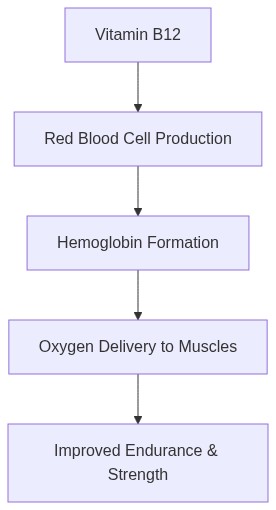
Every rep you do depends on oxygen delivery to working muscles. B12 is essential for hemoglobin formation—the protein in red blood cells that carries oxygen. Without adequate B12, you can't produce enough healthy red blood cells, meaning your oxygen delivery suffers. This translates directly to faster fatigue and reduced work capacity.
Citric Acid Cycle
B12 acts as a co-factor for enzymes involved in the citric acid cycle—the process by which your body converts carbohydrates, fats, and proteins into usable ATP. When you're under the bar for a heavy set, B12 helps ensure your energy systems can keep up with demand.
Nerve Function and Muscle Activation
Your nervous system controls every muscle contraction. B12 is crucial for myelin synthesis—the protective sheath around nerves that allows rapid signal transmission. Stronger nerve signals mean better muscle fiber recruitment and more force production per rep.
Protein Metabolism
Building muscle requires protein synthesis, which depends on methylation reactions. B12 is a co-factor in these reactions, helping process amino acids efficiently. Without it, your post-workout protein might not be utilized as effectively.
Research: What the Studies Show
The science on B12 and athletic performance is clear, though often overlooked.
A study published in PMC7230602 examined B12 status in elite athletes and found that optimal serum levels ranged from 400-700 pg/mL. Athletes within this range showed better performance markers than those below it. The researchers noted that deficiency—even marginal deficiency—impairs exercise capacity.
Research on women athletes has shown a direct correlation between higher B12 status and performance outcomes. Similarly, a 28-day study on B-complex supplementation demonstrated improvements in endurance performance markers. The benefits extend to both strength and endurance activities.
What stands out is that the research consistently shows: B12 isn't optional for athletes. It's foundational.
Signs of B12 Deficiency in Lifters
How do you know if B12 is holding you back? Watch for these symptoms:
- Unexplained fatigue despite adequate sleep and nutrition
- Weakness or stalled progress you can't explain
- Poor recovery between sessions
- Shortness of breath during intense sets
- Brain fog or poor concentration during training
Certain lifters are at higher risk:
- Vegans and vegetarians (no reliable plant sources)
- Older athletes (absorption decreases with age)
- Anyone with GI issues (celiac disease, Crohn's, etc.)
- Those who've had weight loss surgery
If any of these apply to you, B12 deficiency is more likely.
Testing and Optimal Ranges
Here's the uncomfortable truth: you can't feel your way to optimal B12 status. You need data.
Serum B12 testing is the standard, but it has limitations—it measures total B12, not whether your body can actually use it. A better approach is testing methylmalonic acid (MMA)—elevated MMA indicates functional B12 deficiency even if serum B12 looks normal.
For athletes, target 400-700 pg/mL of serum B12 based on the research. Some practitioners recommend aiming higher (600-900 pg/mL) for optimal performance, but the evidence supports 400-700 as the sweet spot.
If you're serious about your training, get baseline blood work that includes B12 and MMA. Re-test after 3-6 months of supplementation to dial in your optimal dose.
Supplementing B12: Practical Guide
If you need to supplement—and many lifters do—here's how to do it right:
Dosage: Typical supplemental doses range from 1000-5000 mcg daily. More isn't necessarily better—excess B12 is excreted in urine—but higher doses can help correct deficiency faster.
Form: Choose methylcobalamin over cyanocobalamin when possible. It's the active form your body uses immediately.
Timing: Sublingual (under-the-tongue) B12 is absorbed better than oral. Take it in the morning with food, or hold it under your tongue for 30-60 seconds.
Stacking: B vitamins work together. A B-complex can be helpful, but ensure you're getting adequate B12 specifically. Other key B vitamins for lifters include B6 and folate.
Food sources: If you eat meat, fish, and dairy regularly, you're likely getting some B12. But most people don't get enough from food alone to reach optimal athletic levels. Good sources include:
- Clams (highest concentration)
- Liver
- Beef
- Fish (trout, salmon, tuna)
- Eggs and dairy
For vegan lifters, fortified foods and supplements aren't optional—they're essential.
Conclusion
Vitamin B12 isn't sexy. It doesn't have the cachet of creatine or the buzz of caffeine. But it's non-negotiable for strength athletes who want to perform at their best. The mechanism is clear: oxygen delivery, energy production, nerve function, and protein metabolism all depend on adequate B12 status.
Don't guess. Test. Get your bloodwork done, aim for that 400-700 pg/mL range, and supplement if needed. Your strength gains—and your energy levels—will thank you.
The bottom line: B12 might be the missing piece when everything else is dialed in but progress still stalls.