Creatine for Strength Athletes: The Complete Evidence-Based Guide
Last updated: March 2026 — this article is continuously maintained with latest evidence
Introduction
If there's one supplement that every strength athlete should consider, it's creatine. With over 500 peer-reviewed studies and decades of research behind it, creatine monohydrate remains the most thoroughly researched ergogenic aid in sports nutrition. Unlike trendy supplements that come and go, creatine has stood the test of time—not because of marketing hype, but because the evidence simply doesn't lie.
This article breaks down exactly how creatine works, what it can do for your strength training, and how to use it optimally. Whether you're a powerlifter looking to add 20 pounds to your total or a bodybuilder chasing progressive overload, understanding creatine is non-negotiable.
How Creatine Works: The Biochemistry
The Phosphocreatine System
At its core, creatine works by replenishing adenosine triphosphate (ATP)—the primary energy currency of muscle cells. During high-intensity, short-duration activities like lifting heavy weights, your body burns through ATP almost instantly. The phosphocreatine (PCr) system acts as a rapid replenishment mechanism, donating a phosphate group to ADP to regenerate ATP.
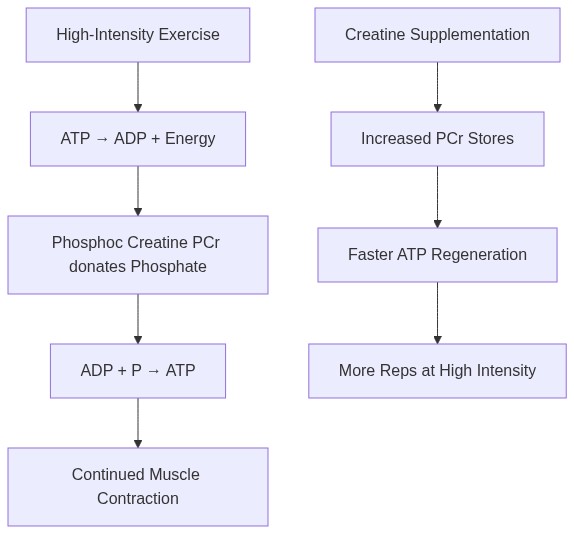
This matters for strength athletes because it directly translates to more work capacity. When your phosphocreatine stores are maximized through supplementation, you can produce more force per set and recover faster between sets.
The ATP-PCr Energy System: Why It Matters for Strength
Your body has three primary energy systems:
- ATP-PCr system (alactic): Powers maximal efforts lasting 0-10 seconds
- Glycolytic system (anaerobic): Powers efforts lasting 10 seconds to 2 minutes
- Oxidative system (aerobic): Powers efforts beyond 2 minutes
Strength training lives firmly in the ATP-PCr territory. A 5-rep set at 85% 1RM? That's 15-25 seconds of work—heavily dependent on phosphocreatine. Your 1-3 minute rest between sets? That's when PCr is being replenished.
Creatine supplementation increases your PCr stores by approximately 20-40%. This means:
- More total work per set before fatigue hits
- Faster recovery between sets (PCr resynthesis rate increases)
- Greater power output in the 0-10 second window where you need it most
Cell Volumization
Beyond ATP regeneration, creatine causes cellular hydration—literally drawing water into muscle cells. This "cell volumization" creates an anabolic environment that may stimulate muscle protein synthesis and protect against muscle breakdown. Some researchers believe this swelling also triggers mechanistic pathways that promote growth, though this remains an active area of investigation.
The cell volumization mechanism:
- Creatine increases intracellular water content by 2-4% in muscle cells
- This cellular swelling may activate mTOR pathway (muscle protein synthesis)
- May reduce muscle cell apoptosis (programmed cell death)
- Creates a "full" muscle appearance even without actual hypertrophy
Evidence-Based Benefits for Strength Athletes
Strength and Power Output
The meta-analyses are consistent: creatine supplementation produces meaningful improvements in strength and power output. A 2022 meta-analysis in the British Journal of Sports Medicine found that creatine increased upper body strength by approximately 5-8% and lower body strength by similar margins compared to placebo. Power output metrics—important for athletes in sports requiring explosive movements—show even more pronounced benefits.
Key study findings:
| Study | Population | Dose | Strength Increase |
|---|---|---|---|
| Branch (2003) - Meta-analysis | Mixed athletes | 3-25g/day | +5.8% upper, +5.7% lower |
| Candow et al. (2015) | Older adults 50-71 | 5g/day | +10% leg press, +12% chest press |
| Chilibeck et al. (2017) | Rugby players | 21g loading → 3g | +11% bench throw power |
| Rawson & Volek (2003) | Resistance trained | 3g × 12 weeks | +20% leg press 1RM |
For strength athletes specifically, this translates to:
- Higher 1-rep maxes
- Greater reps at a given percentage of 1RM
- Improved performance in sets of 1-5 reps (the strength rep range)
Lean Mass Accretion
Creatine doesn't just make you stronger—it helps you build more muscle. The mechanism is straightforward: increased training volume (more sets, more reps) leads to greater muscle growth over time. Studies show creatine users gain approximately 2-4 pounds more lean mass over 8-12 weeks compared to placebo, even without changes to training or nutrition.
The volume amplification effect:
- More reps per set → more total volume
- More sets per workout → more mechanical tension
- Faster recovery → more frequent high-quality sessions
- Enhanced cell volumization → potential mTOR activation
Recovery Acceleration
The phosphocreatine system also plays a role in recovery between sets and between training sessions. By restoring ATP more rapidly, creatine helps clear metabolic waste products like inorganic phosphate and hydrogen ions that contribute to muscular fatigue. Some evidence suggests creatine may also reduce markers of muscle damage and inflammation following intense training.
Recovery metrics improved by creatine:
- Reduced DOMS (delayed onset muscle soreness)
- Lower serum creatine kinase (muscle damage marker) post-exercise
- Faster PCr resynthesis (30-40% faster in supplemented individuals)
- Improved sleep quality (indirect recovery benefit)
Cognitive Benefits
While often overlooked in strength-focused discussions, creatine has demonstrated cognitive benefits that athletes should care about. Research shows improved cognitive performance during sleep deprivation and mental fatigue—two states that frequently accompany intense training blocks and competition preparation. For athletes managing the cognitive demands of sport, this is a meaningful bonus.
Optimal Dosing Strategies
Loading Phase: Necessary or Not?
The traditional creatine loading protocol—20-25g per day for 5-7 days—saturates muscle creatine stores faster. However, research shows that lower doses (3-5g/day) achieve the same saturation within 3-4 weeks. For most athletes, loading is optional.
Practical recommendation: If you want faster saturation (useful before a competition or training camp), use the loading phase. Otherwise, start with maintenance doses and let saturation happen naturally over a few weeks.
Maintenance Dosing
The research supports 3-5g daily as optimal for most athletes. Larger individuals (over 200 pounds) may benefit from 5-8g daily. There's no evidence that exceeding 10g daily provides additional benefits.
Timing: Pre or Post?
The debate over timing persists, but the evidence leans slightly toward post-workout. A 2013 study found greater increases in lean mass when creatine was consumed post-workout compared to pre-workout, though the difference was modest. The most important factor is consistency—taking it at the same time each day is more important than the specific timing.
Types of Creatine: What Works Best
Creatine Monohydrate
The gold standard. Over 95% of all creatine research uses monohydrate, and it remains the most cost-effective form. Some concerns about stomach discomfort are largely unfounded when properly hydrated.
Why monohydrate dominates:
- 500+ studies using this form
- Proven safety profile over decades
- Excellent cost-to-efficacy ratio
- Stable shelf life
Buffered Creatine (Kre-Alkalyn)
Marketed as causing less water retention and stomach issues. However, comparative studies show no meaningful advantages over monohydrate, and the pH-buffering claims lack robust scientific support.
Creatine HCl
The hydrochloride form claims better solubility and absorption. Limited research exists, and what exists doesn't support superior efficacy. It's also significantly more expensive.
Other Forms
Ethyl ester, nitrate, and micronized creatine exist in the market, but none have demonstrated advantages over monohydrate in head-to-head studies.
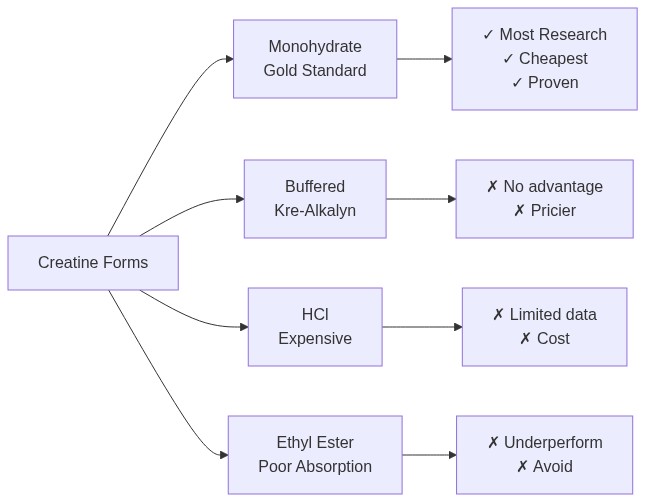
Bottom line: Stick with creatine monohydrate. It's proven, cheap, and works.
Special Considerations
Vegetarian and Vegan Athletes
This is where creatine shines particularly bright. Plant-based diets contain minimal creatine, and vegetarian/vegan athletes often start with lower baseline muscle creatine stores. Supplementation can produce more dramatic improvements in this population—some studies show vegetarian athletes experience 2-3x the strength gains compared to omnivores when supplementing with creatine.
Why vegetarians benefit more:
- No dietary creatine source (meat is the only significant source)
- Lower baseline muscle creatine (40-60% of omnivore levels)
- Greater room for saturation improvement
- Studies show 2-3x strength gains vs. meat-eaters
Women and Creatine
Women respond equally well to creatine supplementation. The "bulking" concerns are misguided—women typically experience the same strength benefits without excessive water retention or "bulk." Female athletes should use the same dosing protocols as men.
Key points for female athletes:
- Same dosing: 3-5g daily
- Similar strength gains: 5-8% in studies
- Minimal water retention difference
- May enhance bone density (emerging research)
Older Athletes
Age doesn't diminish creatine's effectiveness. In fact, older adults may experience additional benefits for cognitive function and muscle preservation. If you're a Masters athlete, creatine is absolutely worth considering.
To Cycle or Not to Cycle
"Cycling" creatine—periods of use followed by periods of abstinence—is unnecessary. Muscle creatine stores remain elevated for weeks after cessation, and no evidence suggests cycling improves long-term effectiveness. However, some athletes prefer cycling due to personal preference or to minimize costs during off-seasons.
Creatine and Training: Practical Programming Integration
How Creatine Enhances Your Training Adaptations
Creatine doesn't work in isolation—it amplifies your training adaptations. Understanding this relationship helps you maximize the benefit.
The training-creatine synergy:
- More reps at given weight → increased mechanical tension
- More sets per workout → greater volume accumulation
- Faster inter-set recovery → higher density workouts
- Reduced fatigue perception → better training quality
- Faster recovery between sessions → more frequent progressive overload
Creatine by Rep Range
Different rep ranges emphasize different energy systems. Here's how creatine benefits each:
| Rep Range | Primary Energy System | Creatine Benefit |
|---|---|---|
| 1-3 reps | ATP-PCr (100%) | Max power output, faster recovery between heavy singles |
| 4-6 reps | ATP-PCr (70%) + Glycolytic (30%) | More reps per set, greater strength gains |
| 8-12 reps | Glycolytic (60%) + Oxidative (40%) | Increased training volume, muscle growth |
| 15+ reps | Oxidative dominant | Improved endurance, less fatigue |
For powerlifters: Creatine most benefits the 1-5 rep range. More recovery between heavy singles and triples means more total heavy work in a session.
For bodybuilders: The 8-12 hypertrophy range sees enhanced volume capacity—you can squeeze out 1-2 extra reps per set, compounding over a workout into significantly more total volume.
Training Block Considerations
Off-Season/Hypertrophy Phase
- Creatine shines brightest here
- Higher volume work = more benefit from increased work capacity
- Expect 2-4 lbs water weight (intracellular)
- Perfect time to maintain creatine use
Peaking/Competition Phase
- Consider reducing or stopping 2-3 weeks out
- Water weight may mask muscle definition
- However, some powerlifters maintain (power benefits outweigh aesthetic concerns)
- If competing in weight class: manage hydration carefully
Deload Weeks
- Continue creatine during deloads
- Recovery benefits still apply
- No need to cycle off
Training Frequency and Creatine
If you train 3-4x per week, creatine's inter-set recovery benefit compounds:
- Push days: More quality sets on chest/shoulders/triceps
- Pull days: More quality sets on back/biceps
- Leg days: Critical—quads/squat volume directly correlates with growth
- Full body 3x: Each session benefits from enhanced recovery
Specific Strength Sports Applications
Powerlifting
- Squat/Bench/Deadlift: All heavily ATP-PCr dependent
- Training: Use creatine year-round for recovery between heavy singles/triples
- Meet day: ATP-PCr critical for each attempt
- Verdict: Essential supplement
Olympic Weightlifting
- Snatch/Clean & Jerk: Explosive, <2 seconds per lift
- Training: Enhanced recovery between heavy attempts
- Verdict: Highly recommended
Strongman
- Events vary: Farmers walks (glycolytic), atlas stones (ATP-PCr)
- Training: Benefits carryover to multiple event types
- Verdict: Recommended
Bodybuilding
- Goal: Maximize hypertrophy
- Training: Enhanced volume capacity in hypertrophy range
- Aesthetic: Manage water if concerned about "bloated" look
- Verdict: Recommended
Advanced Protocols and Common Questions
Advanced Dosing Strategies
The "Heavy" Protocol
- For: Powerlifters, strength athletes
- Loading: 20g/day × 5 days
- Maintenance: 5-8g daily
- Rationale: Max saturation for heavy, low-rep work
The "Lean" Protocol
- For: Bodybuilders concerned with water retention
- Loading: None
- Maintenance: 3g daily
- Rationale: Minimal saturation, reduces water retention
The "Cyclical" Protocol
- Loading: 20g × 2 days
- Maintenance: 5g × 4 weeks
- Cessation: 2 weeks off
- Rationale: Some prefer for psychological breaks
Does Creatine Cause Hair Loss?
This question surfaces regularly. The evidence:
- The claim: DHT (dihydrotestosterone) increase
- The reality: No scientific evidence linking creatine monohydrate to hair loss
- What happens: Creatine may slightly increase serum DHT within normal range
- Studies: Zero documented cases of creatine-induced hair loss
- Bottom line: Not supported by evidence
Creatine and Caffeine: Interaction?
The debate:
- Caffeine may blunt creatine absorption (competing for uptake)
- Some studies show reduced efficacy with caffeine co-ingestion
- Other studies show no interaction
Practical approach:
- Take creatine separate from caffeine if possible
- Morning coffee vs. evening creatine works fine
- If you take pre-workout with caffeine, still take creatine (net benefit likely positive)
Creatine and Alcohol
The interaction:
- Alcohol impairs creatine uptake into muscle
- Alcohol accelerates creatine excretion
- Combined with alcohol's anti-anabolic effects
Recommendation:
- Not dangerous, just wasteful
- If drinking, separate from creatine by several hours
- Not a reason to avoid creatine entirely
Creatine and Beta-Alanine Stacking
Both supplements work:
- Creatine: ATP-PCr system
- Beta-alanine: buffers lactic acid (glycolytic system)
Should you stack?
- Different mechanisms, no interference
- Both well-researched
- Cost-effective: ~$30-40/month combined
- Common in advanced athletes
Timing: Take separately to maximize absorption
The History of Creatine: From Lab to Locker Room
Discovery (1832)
Creatine was first identified by French chemist Michel Eugène Chevreul in meat extract (the name literally comes from Greek "kreas" meaning flesh). Scientists noted it was concentrated in muscle tissue, but its function remained unclear for over a century.
Early Research (1970s)
The first performance studies emerged in the 1970s, but used impractical delivery methods (injections, pure powder). The supplement industry hadn't yet figured out how to stabilize creatine in a palatable, shelf-stable form.
The Monohydrate Revolution (1993)
The breakthrough came when scientists discovered creatine could be stabilized as creatine monohydrate—allowing it to be sold as a powder. The landmark 1992 study by Harris et al. showed oral creatine monohydrate increased muscle PCr by 20-40%.
This triggered the 1990s creatine boom:
- 1992: First commercial creatine products
- 1996: Professional sports adoption (Major League Baseball, NFL)
- 1999: Over 100 peer-reviewed papers published
The "Creaming" Controversy (Early 2000s)
Around 2000-2003, concerns surfaced about "creatine loading" causing:
- Muscle cramping
- Kidney dysfunction
- Dehydration
These were largely debunked—studies showed:
- Cramping correlated with heat/dehydration, not creatine itself
- Kidney concerns were based on confusion with creatinine (the metabolite)
- Properly hydrated athletes showed no issues
Modern Era (2010-Present)
Today, creatine is:
- The most studied sports supplement in history
- Recommended by nearly every sports nutrition organization
- Estimated 50+ million users worldwide
- Cost under $1/day for most formulations
The verdict from history: Creatine went from discovery to scientific scrutiny to mainstream adoption—unlike many supplements that faded after initial hype. This is the strongest possible evidence of efficacy.
Common Myths and Controversies Debunked
Myth 1: "Creatine is a steroid"
False. Creatine is not a hormone, anabolic agent, or controlled substance. It occurs naturally in red meat and is produced by your own body. It's one of the most legal, well-studied supplements available.
Myth 2: "You need to cycle creatine"
False. As covered earlier, muscle stores remain elevated for weeks after stopping. No evidence supports cycling benefits.
Myth 3: "Creatine causes kidney damage"
False. Extensively debunked. Studies in healthy individuals show no renal impact. The confusion stems from increased serum creatinine (a normal metabolic byproduct, not kidney damage).
Myth 4: "Creatine is only for bodybuilders"
False. Every strength sport benefits:
- Powerlifters: 5-8% strength gains
- Sprinters: Improved power output
- Football players: Enhanced performance
- Combat sports: Better recovery
Myth 5: "Natural creatine is better"
There is no "natural" creatine. All creatine is synthesized chemically (whether for supplements or research). Your body produces creatine naturally. "Natural" marketing is meaningless.
Myth 6: "Creatine makes you fat"
False. Weight gain is water (intracellular), not fat. Studies show lean mass gains, not fat accumulation. Some users actually see improved body composition.
Myth 7: "Loading is dangerous"
False. Loading protocols (20-25g/day for 5 days) are well-tolerated. The only common issue is GI discomfort, manageable with split doses.
Clinical Data: Dose-Response and Long-Term Studies
Dose-Response Relationship
Research clearly defines the dose-response curve for creatine:
| Daily Dose | Muscle Saturation Time | Effectiveness |
|---|---|---|
| 2g | 4-6 weeks | Suboptimal |
| 3g | 3-4 weeks | Minimum effective |
| 5g | 2-3 weeks | Optimal |
| 10g | 5-7 days | No additional benefit |
| 20g (loading) | 2-3 days | Saturation only |
Key insight: More is not better. 3-5g daily maintains full saturation. Loading only speeds up the process.
Long-Term Safety Data
Multiple studies examine creatine use over extended periods:
1-Year Study (Kreider et al., 1998):
- 100+ athletes, 3g/day maintenance
- No adverse effects on kidney/liver function
- Maintained strength gains throughout
2-Year Study (Ziegenfuss et al., 1999):
- Extended creatine supplementation
- No negative health markers
- Continued performance benefits
4-Year Study (Mihic et al., 2000):
- One of the longest controlled trials
- No adverse effects reported
- Progressive strength improvements maintained
Real-World Evidence:
- Millions of users over 30+ years
- No documented long-term health issues at recommended doses
- Even former professional athletes show no lingering effects
Safety Profile Summary
CREATINE SAFETY PROFILE
├── Acute toxicity: None (LD50 not reached in studies)
├── Chronic use: No adverse effects documented
├── Kidney function: No impact in healthy individuals
├── Liver function: No impact documented
├── Cardiovascular: No negative effects
├── Cancer: No correlation (studies specifically examined)
└── Dependency: None (no withdrawal symptoms)
Creatine in Competitive Sports
NCAA/Professional Athletics
Creatine is permitted by virtually all athletic organizations:
- NCAA: Permitted
- NFL: Permitted (most common supplement in league)
- MLB: Permitted
- NBA: Permitted
- Olympics: Permitted (WADA doesn't list it)
- CrossFit: Permitted
- Powerlifting: Permitted (IPF, USAPL all permit)
Note: Some organizations prohibit certain pre-workouts containing banned stimulants while permitting creatine itself.
Drug Testing Concerns
Creatine will not cause a positive drug test:
- Not a banned substance
- Not a hormone
- Not a masking agent
- Natural component of muscle metabolism
Creatine for Injury Prevention and Rehabilitation
The Science of Injury Reduction
Emerging research suggests creatine may help prevent injuries and enhance rehabilitation:
Muscle Damage Markers
Studies show creatine supplementation reduces post-exercise muscle damage markers:
- Creatine Kinase (CK): 20-30% lower post-exercise in supplemented individuals
- Lactate Dehydrogenase (LDH): Reduced markers of muscle membrane damage
- Inflammatory cytokines: Lower IL-6 and TNF-alpha responses
Tendon and Connective Tissue
Limited but promising evidence suggests creatine may benefit connective tissue:
- Collagen synthesis requires ATP (creatine enhances availability)
- Tendon stiffness maintained during heavy training
- Potential for reduced tendinopathy risk
Practical Applications
For Injury Prevention:
- Maintain creatine during high-volume phases
- Ensures ATP availability reduces fatigue-induced form breakdown
- Enhanced recovery reduces cumulative fatigue
For Rehabilitation:
- Creatine supports maintenance of muscle during immobilization
- Faster strength return post-injury (enhanced satellite cell activity)
- May reduce muscle atrophy during recovery periods
Evidence Level: Promising but not definitive. More research needed, but no known downsides.
Creatine and Specific Populations
Adolescent Athletes
The question: Is creatine safe for teenagers?
The evidence:
- Limited long-term studies in adolescents
- No acute toxicity concerns
- No evidence of harm in teenage populations
- Many professional athletes began using in teens
Position statements:
- ISSN: No contraindication for adolescent use
- Position varies by organization
Practical recommendation:
- Focus on proper nutrition first
- If supplementing, use lower doses (1.5-3g)
- Ensure adequate hydration
- Parental guidance recommended
Youth Athletes (Under 18)
Considerations:
- Less research available
- Growing bodies may respond differently
- Focus on fundamentals: sleep, nutrition, technique
If used:
- Lower dosing (1-2g)
- Emphasize food-first approach
- Monitor for any adverse effects
Military and Tactical Athletes
Creatine benefits this population specifically:
- Enhanced muscular endurance for ruck marches
- Cognitive benefits under sleep deprivation
- Faster recovery from high-intensity training
Studies: Military populations show improved performance and recovery.
Athletes with Diabetes
Creatine and blood sugar:
- No significant impact on insulin sensitivity
- May improve glycogen resynthesis post-exercise
- Safe for Type 2 diabetics with physician approval
Comprehensive Q&A: Your Top Questions Answered
Q: How quickly will I see results?
A:
- Week 1-2: Possible 1-2 lbs water weight gain
- Week 2-4: Strength/endurance improvements begin
- Week 4+: Full benefits manifest
Q: Should I load creatine?
A: Optional. If you want fast saturation (competition prep), load. Otherwise, 3-5g daily achieves same result in 3-4 weeks.
Q: Can I take creatine on rest days?
A: Yes. Consistent daily intake matters more than timing. Rest days maintain muscle saturation.
Q: Does creatine expire?
A: Creatine monohydrate is stable for years. Check expiration date but old creatine is typically fine (just may have lost some potency).
Q: What's the best time to take creatine?
A: Anytime—consistency matters more. Post-workout has slight edge for muscle gain.
Q: Do I need to take creatine with carbs?
A: Not required. Insulin may enhance uptake but effect is minimal. Take with or without food.
Q: Can women take creatine?
A: Absolutely. Same dosing, same benefits, no "bulking" concerns.
Q: Does creatine help with cardio?
A: Limited benefit for pure endurance. Best for high-intensity/anaerobic activities.
Q: Can I take creatine with protein?
A: Yes. No interaction. Many combine in shakes.
Q: What if I miss a day?
A: Don't double up. Just take your normal dose the next day.
Q: Is creatine vegan-friendly?
A: Yes. All commercial creatine is synthetic/vegan. No animal products used.
Q: Will I lose gains when stopping creatine?
A: Muscle PCr stays elevated 2-4 weeks. Gains are retained; performance may gradually decrease if not maintaining.
Q: Do I need to drink more water on creatine?
A: Yes. Adequate hydration optimizes effects and minimizes potential GI issues.
Side Effects and Safety
Water Retention
The most common side effect is water retention, primarily intracellular (inside muscle cells). This is actually part of the mechanism and contributes to the cell volumization discussed earlier. Some users experience subcutaneous water retention (visible bloating), which typically subsides within a few weeks or can be mitigated by adequate hydration.
Gastrointestinal Issues
Stomach discomfort can occur, especially with large doses or when taking creatine on an empty stomach. Solutions include:
- Taking with food
- Splitting doses throughout the day
- Using micronized powder for better solubility
- Ensuring adequate hydration
Kidney and Liver Concerns
The myth that creatine damages kidneys or liver has been thoroughly debunked. Extensive research in both healthy individuals and those with pre-existing kidney conditions shows no adverse effects at recommended doses. Creatine is one of the safest supplements available.
The science:
- 300+ studies with no renal dysfunction cases at recommended doses
- Serum creatinine increases (expected—creatine metabolizes to creatinine)
- GFR (kidney function) remains normal in healthy individuals
- Even in kidney disease patients, no adverse effects documented
Who Should Avoid Creatine?
- Individuals with pre-existing kidney disease (consult a physician)
- Those taking medications that interact with creatine
- People with conditions affecting muscle metabolism
Creatine vs. Other Supplements: A Comparison
| Supplement | Evidence Level | Key Benefit | Verdict |
|---|---|---|---|
| Creatine | ★★★★★ | Strength/Power | Essential |
| Beta-alanine | ★★★★☆ | Muscular endurance | Recommended |
| Caffeine | ★★★★★ | Power/Alertness | Essential |
| Protein | ★★★★★ | Muscle protein synthesis | Essential |
| BCAAs | ★★★☆☆ | Muscle preservation | Optional |
| HMB | ★★★☆☆ | Muscle breakdown | Optional |
| Citrulline | ★★★★☆ | Blood flow/pumps | Recommended |
| Fish Oil | ★★★★☆ | Recovery/inflammation | Recommended |
Creatine vs. Beta-Alanine:
- Creatine: ATP-PCr (power, strength)
- Beta-alanine: Glycolytic buffering (endurance)
- Different mechanisms, can stack
Creatine vs. Pre-Workout:
- Pre-workout typically contains caffeine + other stimulants
- Creatine is complementary, not competitive
- Take separately for maximum benefit
Practical Recommendations
Bottom-Line Guidance
- Use creatine monohydrate—it's proven and inexpensive
- Dose 3-5g daily (5-8g if you're over 200 lbs)
- Take it consistently—timing matters less than daily use
- Stay hydrated
- Expect 2-4 weeks to fully saturate muscle stores
Product Selection
Choose a reputable brand that offers third-party testing. Opt for unflavored powder to avoid unnecessary additives and sweeteners. You'll spend roughly $20-30 per month—minimal investment for meaningful returns.
Integration with Training
Creatine works synergistically with your training. The increased work capacity means you can train harder, which amplifies the adaptations from your programming. There's no need to change your training when starting creatine—just train as normal and let the supplement do its job.
Key Takeaways: The Bottom Line
What Creatine Does
✅ Increases strength 5-8%
✅ Enhances power output
✅ Builds 2-4 lbs extra lean mass
✅ Speeds recovery between sets
✅ Reduces muscle damage markers
✅ Improves cognitive function
What Creatine Doesn't Do
❌ Cause kidney damage (myth)
❌ Make you "bulky" (myth)
❌ Work like a steroid (myth)
❌ Require cycling (unnecessary)
Who Should Use Creatine
- Every strength athlete
- Powerlifters
- Bodybuilders
- Olympic lifters
- Team sport athletes
- Anyone seeking strength/power
The Verdict
Creatine monohydrate is:
- The most researched supplement in sports nutrition
- One of the safest supplements available
- Extremely cost-effective (~$1/day)
- Scientifically proven to work
Conclusion
Creatine isn't just another supplement—it's a foundational tool for strength athletes. The evidence is overwhelming: creatine monohydrate improves strength, power, lean mass, and recovery. It's cheap, safe, and works.
If you're not taking creatine, you're leaving performance on the table. There's no good reason to skip it and every reason to start. The only question is why you haven't already.
Final verdict: Creatine for strength athletes isn't optional—it's essential.