Calcium for Strength Athletes: The Forgotten Mineral for Muscle and Power
Most lifters can tell you exactly how many grams of protein they're eating. They've timed their creatine loading phase down to the day. But ask them about their calcium intake, and you'll get a shrug. That's a mistake. Calcium isn't just about bones—it's fundamental to every muscle contraction you make in the gym.
The Science: Calcium's Role in Muscle Function
When your brain sends a signal to lift something heavy, that signal travels down a motor neuron and reaches your muscle fiber. But the signal doesn't directly grab the muscle. It triggers a cascade that starts with calcium.
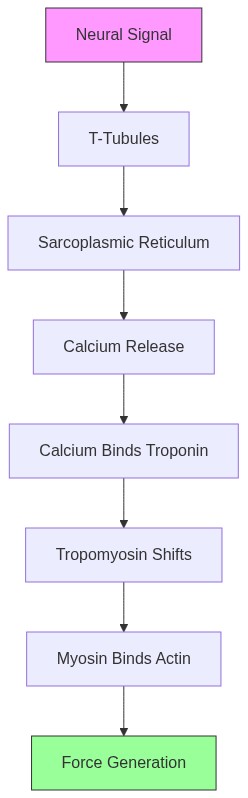
Here's what happens: the action potential travels down the T-tubules of your muscle cells, which stimulates the sarcoplasmic reticulum—a specialized organelle that stores calcium—to release its contents into the muscle cytoplasm. This calcium flood is what kicks everything into gear.
Calcium binds to troponin, a regulatory protein on the actin filament. This binding causes tropomyosin to shift position, exposing the myosin-binding sites on actin. Myosin heads can now attach to actin, pull, and generate force. This is the fundamental sliding filament mechanism behind every rep you do.
Without adequate calcium, this process breaks down. Not dramatically—you won't suddenly drop the bar. But your force production decreases, your rate of force development slows, and your muscles fatigue faster. Research in the Journal of Sports Sciences found that calcium-deficient individuals showed reduced neuromuscular efficiency, meaning their muscles weren't converting neural signals into force as effectively.
Calcium and Strength Performance
The direct research on calcium supplementation and strength outcomes in athletes is surprisingly limited. Most studies focus on bone health or general population health. But the mechanistic evidence is compelling, and several indirect findings point to calcium's importance.
First, there's the neuromuscular fatigue angle. Calcium handling is directly involved in muscle fatigue. During prolonged or intense exercise, calcium accumulation in the cytosol and impaired reuptake into the sarcoplasmic reticulum contribute to the decline in force production. Athletes with suboptimal calcium status may be more susceptible to this fatigue pathway.
Second, consider the sweating equation. Calcium is lost in sweat. Studies show anywhere from 20 to 60 milligrams of calcium lost per liter of sweat, depending on intensity and individual variation. Heavy trainers sweating 2-3 liters per session could be losing significant calcium over time, especially if they're training daily.
Third, there's the hormonal connection. Calcium works alongside vitamin D and parathyroid hormone to regulate the hormones that govern muscle protein synthesis and bone remodeling. Low calcium can elevate parathyroid hormone (PTH), which, chronically elevated, can promote muscle protein breakdown and impair recovery.
Calcium, Bones, and Long-term Athletic Longevity
This is where calcium gets the most attention, and rightly so. Resistance training places unique demands on your skeleton. You're not just bearing weight—you're creating forces that stimulate bone remodeling. Bone responds to the mechanical loading from lifting by becoming denser and stronger. But this remodeling requires raw materials.
Calcium is the primary mineral in bone. When calcium intake is insufficient, your body steals it from your bones to maintain blood calcium levels for critical functions like nerve signaling and muscle contraction. Over time, this creates a net bone loss, even while you're getting stronger in the gym.
For younger athletes, this might not seem urgent. But the consequences compound. Stress fractures are one of the most common injuries in strength sports, and they disproportionately affect athletes with suboptimal bone mineral density. The research is clear: athletes in weight-bearing sports have higher bone density than non-athletes, but only if they're consuming adequate calcium to support the remodeling process.
The vitamin D and K2 partnership deserves mention here. Calcium doesn't work in isolation. Vitamin D enhances calcium absorption from the gut and its reabsorption in the kidneys. K2 directs calcium into bones rather than soft tissues and arteries. Without adequate D and K2, even good calcium intake may not translate to strong bones. Many athletes already supplement D, but K2 is less commonly addressed.
How Much Do Strength Athletes Need?
The RDA for calcium is 1,000 mg per day for most adults and 1,200 mg for women over 50 and men over 70. But "RDA" stands for "Recommended Dietary Allowance"—the amount to prevent deficiency disease, not necessarily the amount for optimal function in athletes.
The International Society of Sports Nutrition position stands don't specify calcium requirements for athletes, but the Academy of Nutrition and Dietetics suggests athletes may need 1.2 to 1.5 times the RDA for various nutrients, including minerals lost in sweat. This puts serious athletes in the 1,200 to 1,500 mg range.
Several factors affect individual needs:
- Training volume: Higher volume means more sweat, more calcium loss
- Body size: Larger athletes may need more absolute calcium
- Diet quality: High-protein diets increase calcium excretion somewhat
- Caffeine intake: Each cup of coffee increases calcium loss modestly
- Menstrual status: Female athletes with amenorrhea have higher calcium needs
- Age: Athletes over 40 have reduced calcium absorption efficiency
The tolerable upper limit is 2,500 mg per day for adults. Going significantly above this can cause hypercalcemia—symptoms include nausea, confusion, kidney stones, and cardiac issues. More isn't better. The goal is adequacy, not mega-dosing.
Food sources are always preferable. Excellent calcium sources include:
- Dairy products (yogurt, cheese, milk)
- Canned fish with bones (sardines, salmon)
- Leafy greens (kale, bok choy, broccoli)
- Fortified foods (plant milks, orange juice)
- Tofu set with calcium sulfate
One serving of Greek yogurt provides about 200 mg. A cup of cooked kale offers around 250 mg. Three ounces of sardines delivers about 325 mg. Most athletes who eat dairy can hit their targets through food alone.
Supplementation makes sense when dietary intake falls short. Calcium carbonate is cheap and effective but requires stomach acid for absorption—take with meals. Calcium citrate absorbs better without food and is better for those on acid reducers. Split doses above 500 mg—your gut absorbs less when you take more at once.
Practical Recommendations
Here's how to apply this:
Get your baseline. If you've never had your calcium checked, ask your doctor for a comprehensive metabolic panel. It measures blood calcium, which tells you if you're acutely deficient. Note: blood calcium is tightly regulated, so it may appear normal even with inadequate bone calcium. For a fuller picture, request bone mineral density testing if you have risk factors.
Track your food. Use a tracking app for a typical week and note your calcium intake. If you're hitting 1,000+ mg through food, supplementation may be unnecessary.
Time it right. If you supplement, consider splitting doses—take 500 mg in the morning, 500 mg with dinner. Don't take calcium and iron supplements simultaneously; they compete for absorption.
Mind the interactions. High sodium intake increases calcium excretion. Caffeine does modestly increase calcium loss. But these effects are manageable within a balanced diet.
Don't forget D and K2. Get your vitamin D levels checked—most athletes are deficient, especially in winter. Consider 1,000 to 4,000 IU daily, titrated to blood levels. K2 supplementation (100-200 mcg of MK-7) is cheap insurance for directing calcium to your bones.
Key Takeaways
Calcium is non-negotiable for strength athletes. It directly enables muscle contraction, affects neuromuscular performance, and provides the building blocks for bone remodeling that keeps you training injury-free for years. Most athletes need 1,200 to 1,500 mg daily, obtainable through dairy, leafy greens, and fortified foods—or supplementation when needed. Pair calcium with adequate vitamin D and K2 for maximum benefit.
Skip the calcium at your peril. Your muscles and your skeleton will feel it.